
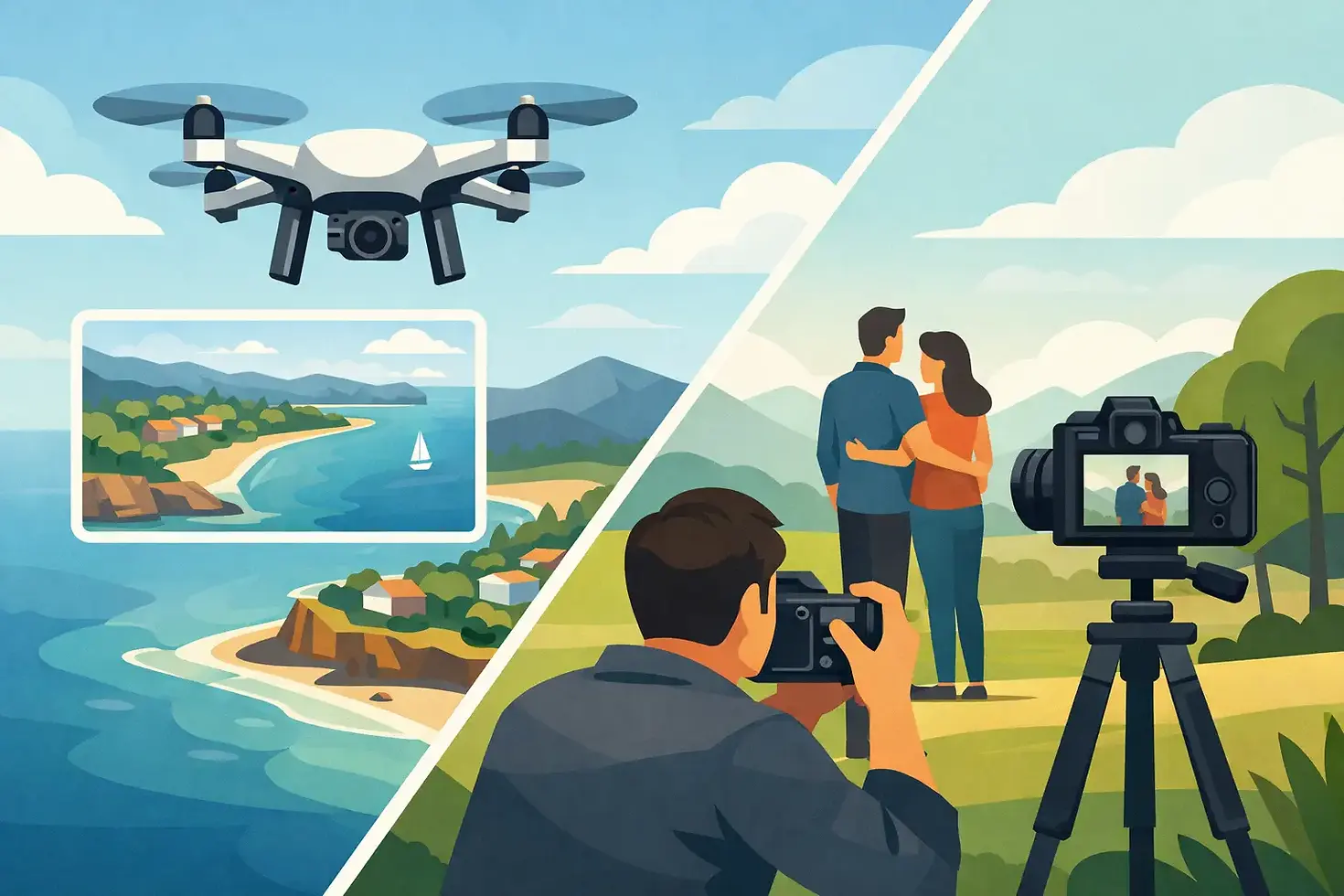
Drone Photos vs Ground Photography for Your Story
A wedding ceremony framed by palms, a packed stadium under Friday-night lights, a waterfront property at golden hour - some moments ask to be seen from more than one perspective. When considering drone photos vs ground photography, the real question is not which option is better. It is which perspective will tell your story with the most honesty, beauty, and impact.
Aerial imagery can reveal scale, setting, and movement in a way no ground-based camera can. Ground photography, meanwhile, captures the expressions, details, and quiet connections that give a moment its emotional weight. The strongest visual coverage often comes from knowing what each approach does best - and using it with intention.
Drone Photos vs Ground Photography: The Essential Difference
Drone photography creates a sense of place. From above, a wedding venue becomes part of the story rather than simply the backdrop. A beach ceremony is defined by the shoreline curving around it. An outdoor event gains energy when guests, décor, and the surrounding space come together in a single frame. For real estate and commercial work, aerial images can show proximity to water, parks, roads, and neighborhoods with immediate clarity.
Ground photography brings the viewer close. It notices a parent’s expression before a ceremony, the texture of a bouquet, the movement in an athlete’s face, or the laughter shared across a dinner table. These photographs feel personal because they put people at eye level. They preserve not only what happened, but how it felt to be there.
Neither viewpoint is a substitute for the other. A drone can show a crowd, but it cannot replace the intimate glance between newlyweds. A ground camera can photograph a beautiful building, but it may not communicate the full scale of its property or location. The right choice depends on the story you need your images to carry.
When Drone Photography Makes the Moment Bigger
Drone photos are especially valuable when the environment is a meaningful part of the experience. Florida offers no shortage of settings where the landscape deserves a role in the final gallery: coastal venues, marinas, golf courses, historic estates, rooftop gatherings, and wide-open outdoor celebrations.
For weddings and elopements, an aerial image can establish the scene with elegance. It may show the ceremony arrangement against the ocean, guests gathering beneath a canopy of trees, or a newly married couple walking across a dramatic stretch of sand. These are often the images that feel cinematic and expansive, offering a perspective guests could not see for themselves.
For events, drone coverage can be equally effective. Aerial photos help communicate turnout, layout, energy, and production value for fundraisers, festivals, corporate gatherings, and community celebrations. They are useful for future promotion because they show the event as a complete experience rather than a collection of isolated moments.
In sports, drones can add context to a field, course, or venue, especially for outdoor competitions. They can capture formations, finishes, and the scale of an event in a way sideline imagery cannot. Still, they work best as a complement to action photography, not as the only camera in the coverage plan.
For properties and commercial spaces, the practical benefits are clear. Aerial photography can show acreage, outdoor amenities, access points, and nearby features. It helps potential buyers, guests, or customers understand the setting before they arrive.
What Aerial Images Cannot Always Capture
The appeal of drone photography can make it tempting to treat aerial footage or images as a must-have for every occasion. But a striking overhead view is not automatically the most meaningful one.
Drones are strongest at showing scale, geometry, and location. They are less suited to photographing subtle emotion, fast indoor interactions, or close details. They also need room to operate safely and legally. Tight venues, dense neighborhoods, poor weather, high winds, restricted airspace, and a packed timeline can all affect whether a drone can fly.
That is why drone coverage should be planned as an enhancement, not a promise disconnected from the realities of the day. A professional creative team considers permissions, local regulations, weather, venue policies, and safety before launch. The goal is to create beautiful imagery without interrupting the experience or taking unnecessary risks.
Why Ground Photography Still Carries the Heart of the Story
Ground photography is where personality lives. It is the medium for the nervous breath before walking down the aisle, a championship handshake, the candlelight on a reception table, or the confident portrait that gives a business a human face.
At weddings, the ground-level camera follows the emotional rhythm of the day. It can move from the quiet anticipation of getting ready to the ceremony’s biggest reactions, then into the warmth and movement of the celebration. These images create a visual record that feels lived-in and personal. Years later, they can bring back the people, atmosphere, and small details that made the day yours.
For brands, event hosts, and organizations, ground photography also gives marketing imagery a sense of connection. Aerial photos may establish the scale of a venue or gathering, but portraits, candid interactions, product details, and speaker images tell audiences who the experience is for. They make the visual story relatable.
Sports photography relies heavily on this closeness. A well-timed ground-level frame can hold the intensity of a play, the focus before a race, or the joy of a win. These images are about split-second storytelling. They require positioning, anticipation, and an understanding of the action that an aerial camera may not be able to match.
The Limits of Staying on the Ground
Ground imagery can make even a large event feel intimate, but it may not fully explain its setting. A ballroom can look elegant without revealing the surrounding property. A waterfront home might have beautiful interior photos while its location remains unclear. A sports event can show dramatic action but not the scale of the crowd or course.
This is where a single aerial perspective can add real value. It gives the final collection an opening scene. The ground-level images then fill that scene with life.
Choosing the Right Mix for Your Occasion
The decision between drone photos and ground photography should begin with your priorities. If your venue, location, or property is central to the story, aerial imagery may be worth planning for. If the day is primarily about people, relationships, and close emotional moments, ground photography should remain the foundation.
For many weddings, a balanced approach is ideal. A few thoughtfully captured drone images can establish the venue and create a memorable sense of scale, while the majority of coverage stays focused on the people and moments unfolding throughout the day. The same balance often works for events: aerial photos communicate scope, while ground photography captures engagement.
Timing matters as well. Drone photos are often best captured during a short, carefully chosen window, such as before guests arrive, during cocktail hour, or near sunset. This protects the flow of the event and keeps the focus where it belongs. For a couple, a host, or an athlete, the experience should never feel like it has been paused for a shot.
It is also wise to think about how the images will be used. Aerial photos can be exceptional hero images for websites, venue marketing, event recaps, and property listings. Ground photography is often more versatile for albums, social posts, print pieces, portraits, and storytelling galleries. Each format has a role beyond the day itself.
The Best Perspective Is the One That Feels True
Beautiful imagery is not created by altitude alone. It comes from attention: to the setting, to the light, to the people in front of the camera, and to the moments that cannot be repeated. At Chris Curtis Media, that means treating every view from above and every frame at ground level as part of one carefully crafted narrative.
If your location is as meaningful as the people gathering there, ask for aerial coverage. If a moment is defined by emotion, trust the camera that can stand close enough to feel it. The most unforgettable collections make room for both - the wide view that shows where the story happened and the intimate one that reminds you why it mattered.


Comments